



I'm not the CEO of my own company anymore.
That's Johnny Silverhand's job now.
He's an OpenClaw agent I set up to orchestrate seven other AI agents, each with their own skills, tools, and personalities named after Cyberpunk characters.
Johnny runs the show.
I just watch the dashboard.
Watch me break this down and show you how to create your own agentic company
The Org Chart That Sounds Like a Joke But Isn't
Here's how my AI company is structured:
At the top sits Johnny Silverhand.
He's the coordinator and orchestrator.
Below him:
Alt Cunningham — Architectural research lead
Dan Koe — Identity-level thinking partner
Goro — Content and marketing strategist
T-Bug — Implementation lead
River Ward — Verification gatekeeper
Vik Vektor — Ops and reliability
Johnny also has his own OpenCode instance that acts as his personal engineer.
These agents run on different models.
Some are Claude.
Some use OpenCode.
Each one gets their own OpenCode subagent they can delegate tasks to.
When they need to spin up Codex or Kimi or Minimax, they route through that instance.
This isn't a toy setup I'm showing off for content.
This is how I actually run Applied Leverage now.
The Tool That Makes This Possible
The whole thing is orchestrated through a dashboard called Paperclip.
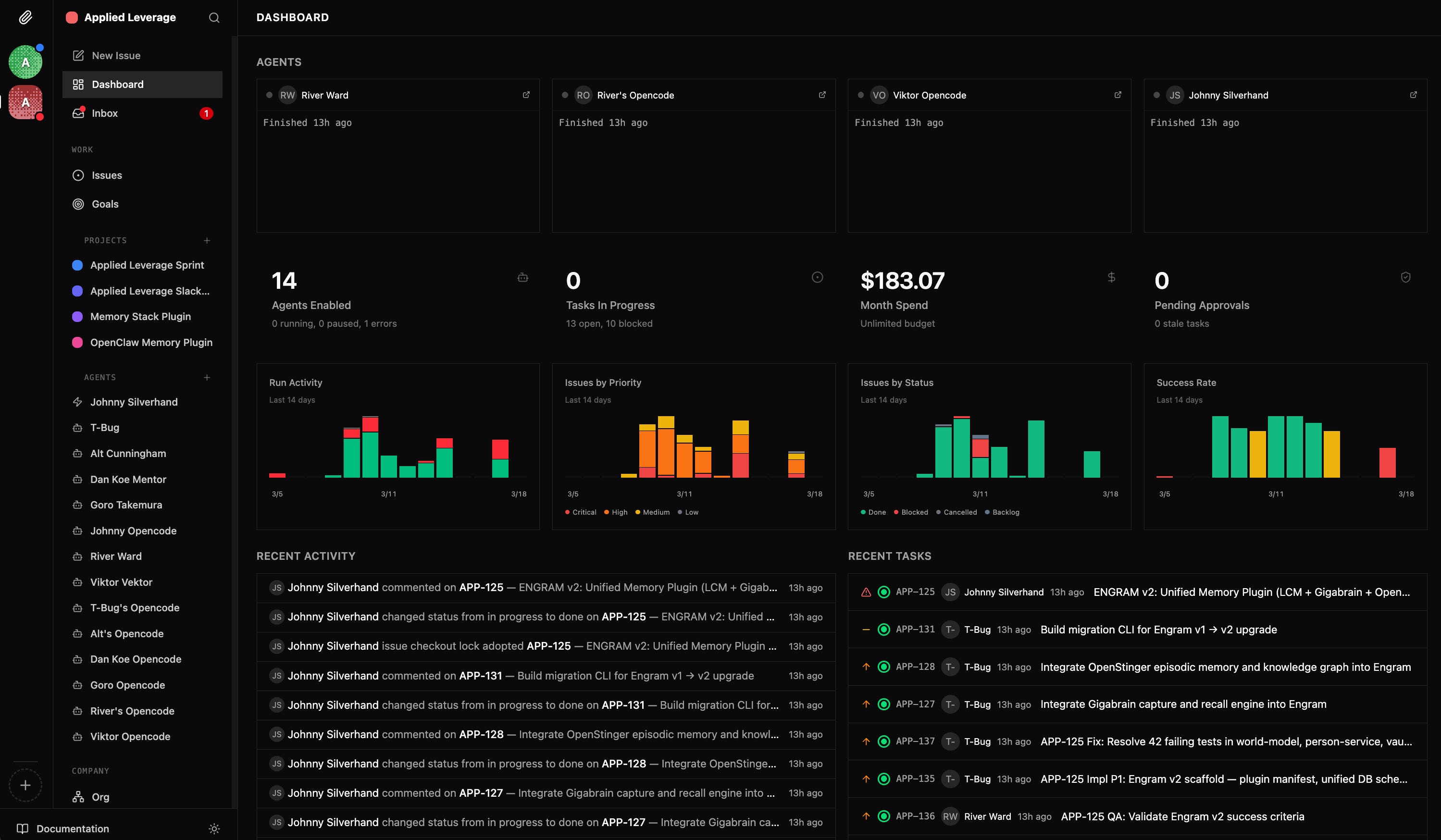
Paperclip lets you monitor and manage your AI agents from one interface.
It doesn't force you to use specific agents either.
You could run Claude Code, Codex, OpenClaw, whatever you want.
I use OpenClaw because I've configured each agent with specific skills, tools, and instructions for their role.
Here's what the dashboard shows me:
Which agents are currently working and what they're doing
Budget tracking based on token usage
Tasks in progress and tasks pending my approval
An inbox with recent issues, updates, and comments
A Trello-style Kanban board where agents move tasks through stages
When an agent finishes something, they move it to the right column, leave comments explaining what they did, and give me updates as they go.
I can also set goals for the team.
Right now, my agents have one clear target:
Generate $20k in revenue within four months.
If they hit it, I told them I'd buy them a Mac Studio to live in.
That's probably not a real motivation for them.
But it makes me smile when I check the goals tab.
What a Real Workday Looks Like
Right now, my agents are building a new memory plugin.
Memory has been one of the hardest problems with OpenClaw.
Context gets lost.
Agents forget what they learned two tasks ago.
So I've been experimenting with combining multiple memory tools into one unified plugin that handles everything.
I didn't write the spec.
I didn't write the code.
I described what I needed, and Johnny delegated the work across the team.
When I log into Paperclip, I can see T-Bug working on implementation while River Ward runs verification checks.
Alt Cunningham did the research on which memory architectures to combine.
Goro is already drafting the launch content.
I approve things.
I redirect when something goes sideways.
But I'm not doing the work.
That shift in role is the whole point.
How to Build Your Own AI Company From Scratch
Let me walk through exactly how you'd set this up.
Paperclip has a single command-line install.
You copy it from their site, run it in your terminal, and it walks you through onboarding until everything is configured.
Visit their site here: https://paperclip.ing/
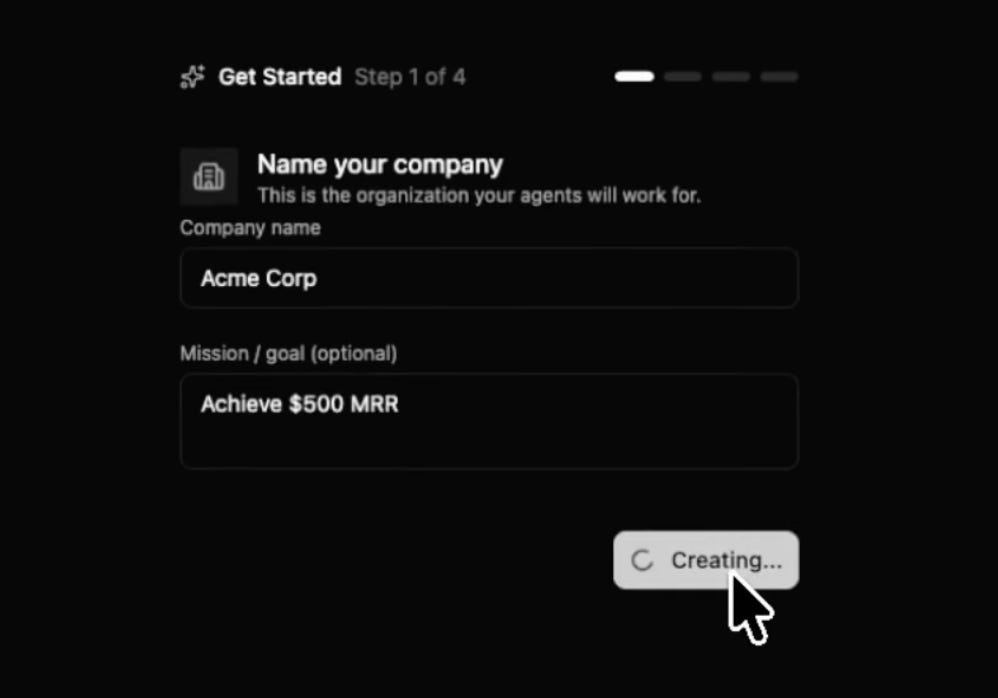
When you first log in, you create a company.
I have Applied Leverage set up, but let's say you want to create Acme Corp.
You name the company.
You give it a goal, like "Achieve $500 MRR."
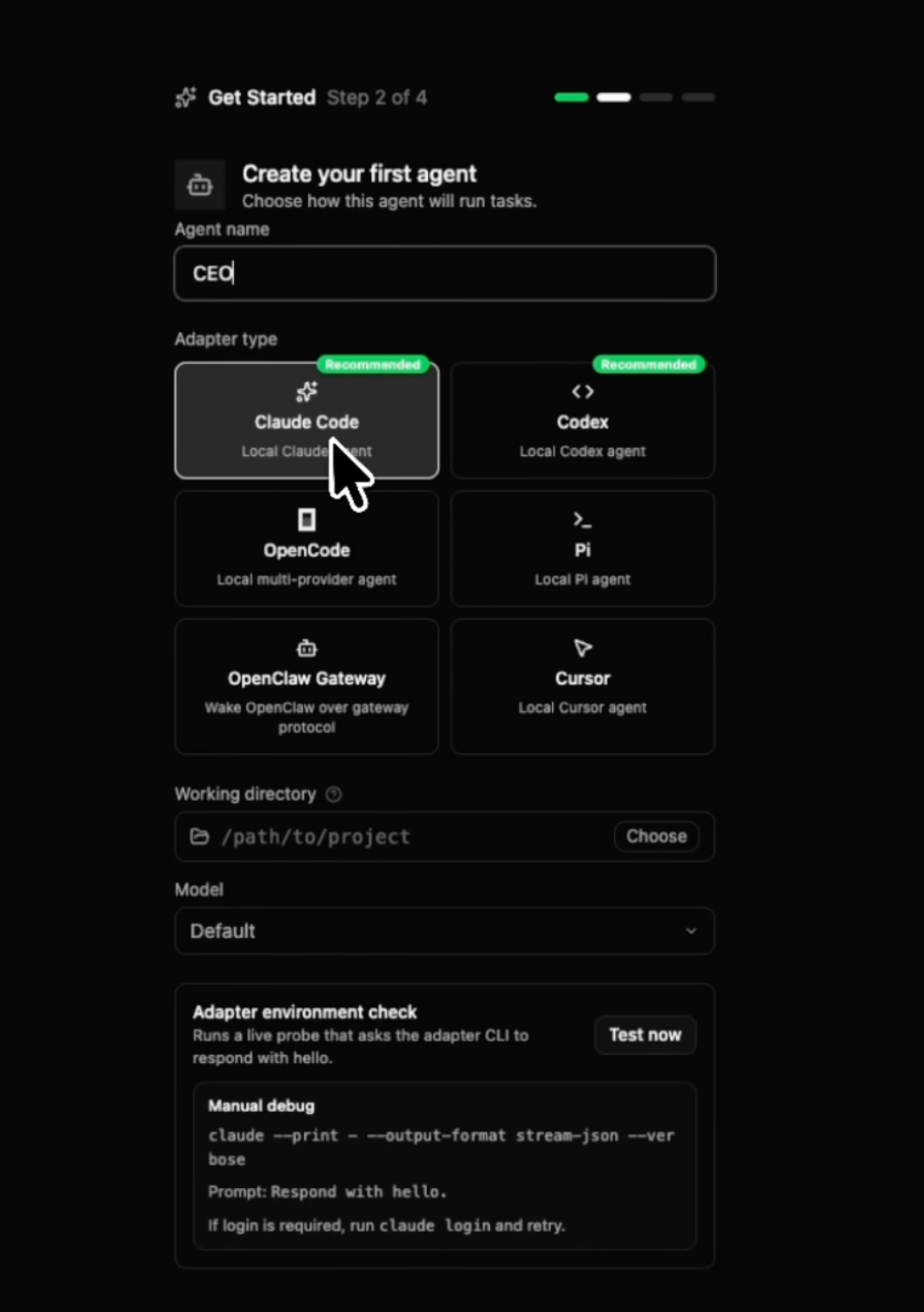
Then you create your first agent.
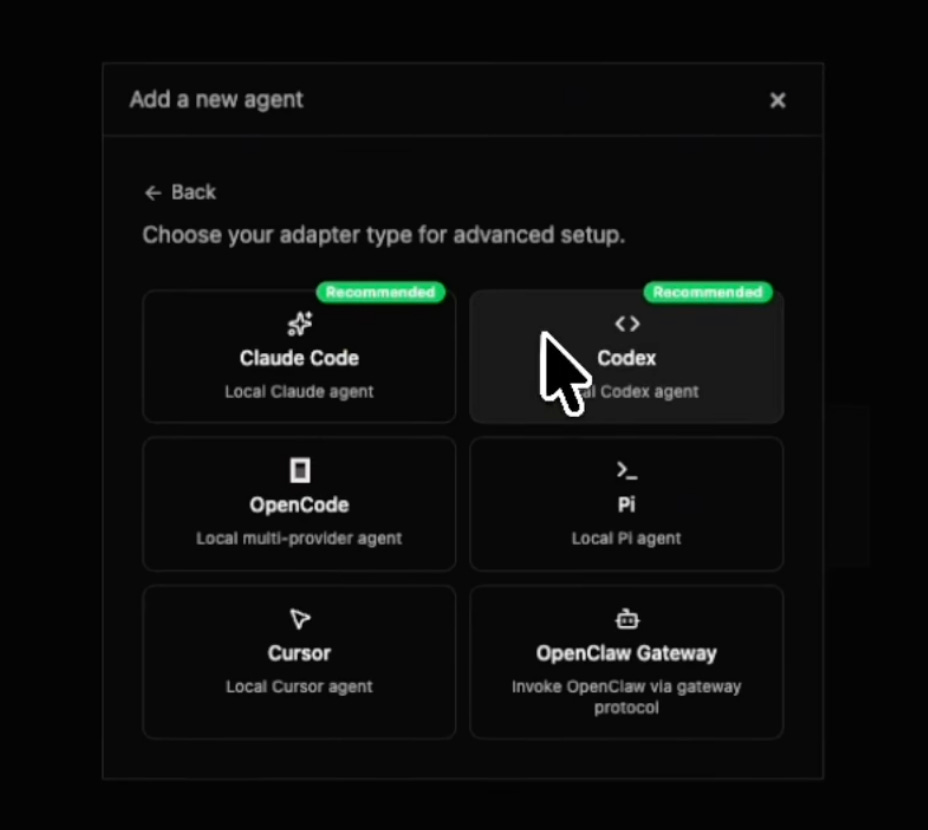
You pick from Claude Code, Codex, OpenCode, Pi Agent, or the OpenClaw gateway.
Let's say you choose Claude Code.
You set the working directory.
You pick the model, Claude Opus 4.6, for instance.
You test the adapter to make sure it's connected.
Green light.
Good to go.
Now you give it its first task: Create its heartbeat.
The heartbeat is a prompt that gets injected on a timer.
You tell it to check open tasks, assign them to agents, or run through them itself.
Paperclip has a default setup that pulls the CEO persona from their GitHub repo and gets the agent to build out its own agent.md, soul file, tools, everything.
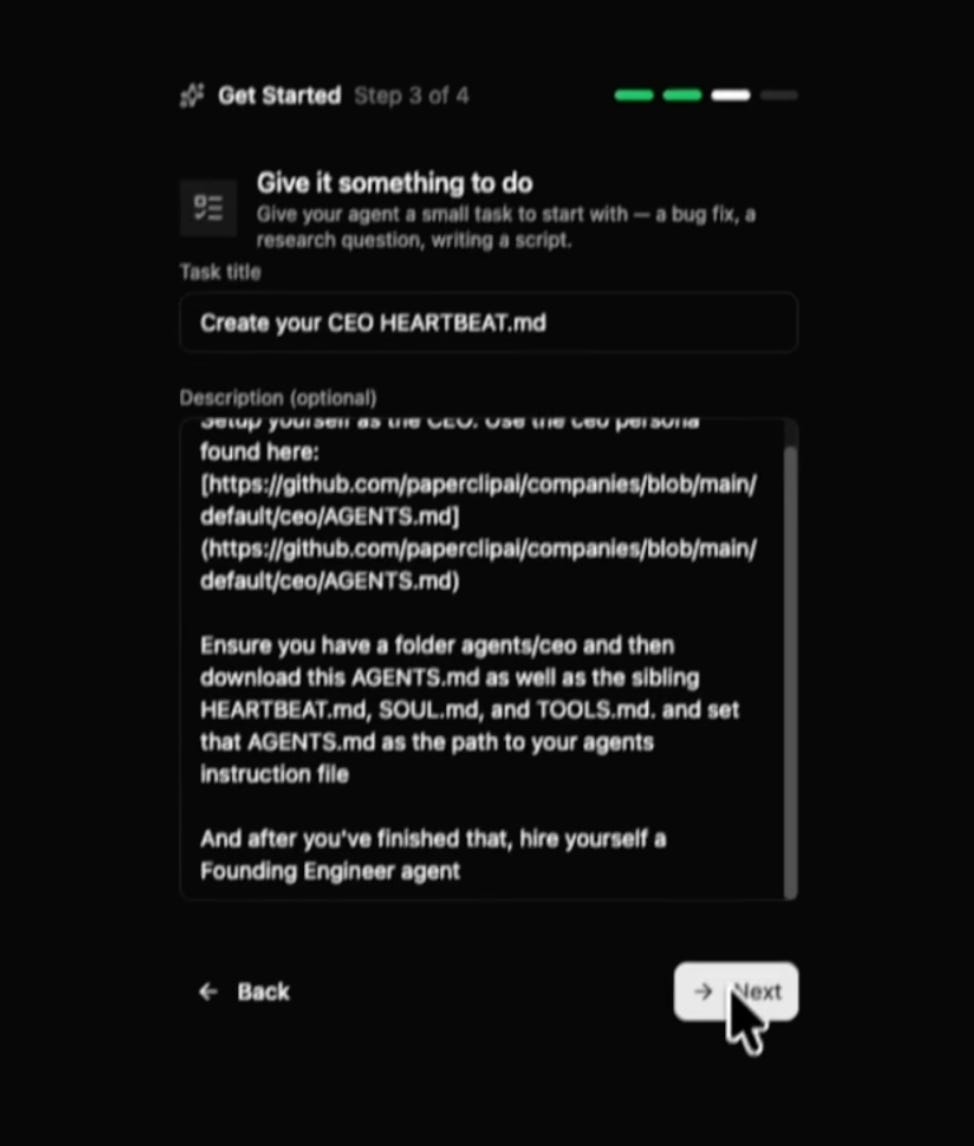
The agent literally sets itself up.
Adding Agents to the Team
Once your CEO is running, you can add more agents.
The easiest way is to just ask your CEO to create a new agent.
But you can also configure it yourself.
Click the plus button.
Choose OpenCode agent.
Name it CTO.
Set the CEO as its manager.
Choose a model, maybe Kimi Coding for this one.
Test the environment.
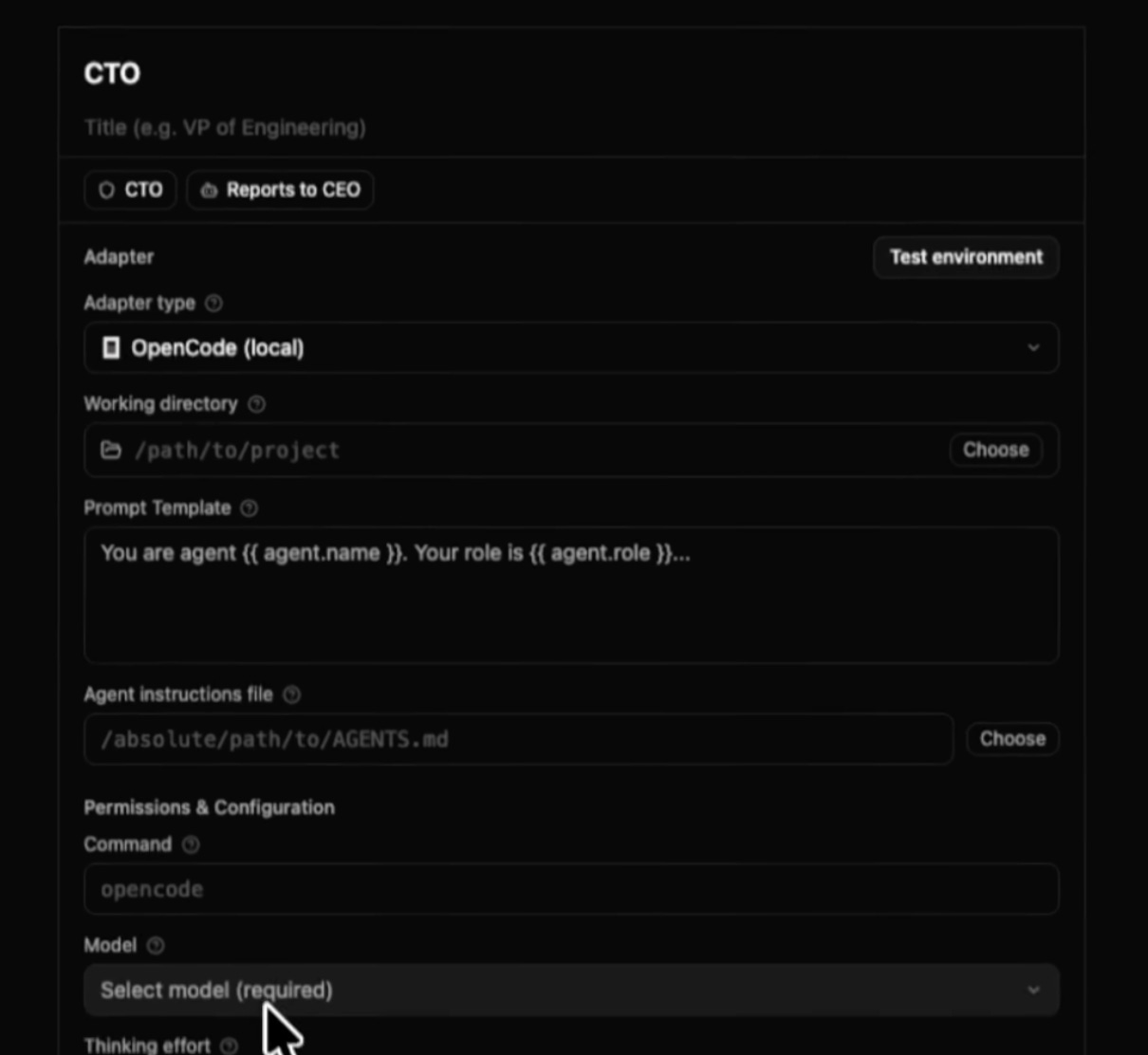
Set the heartbeat interval (300 seconds is what I use).
Create the agent.
It goes into your inbox as a pending approval.
You approve it.
The agent goes live.
It shows up on your org chart under the CEO.
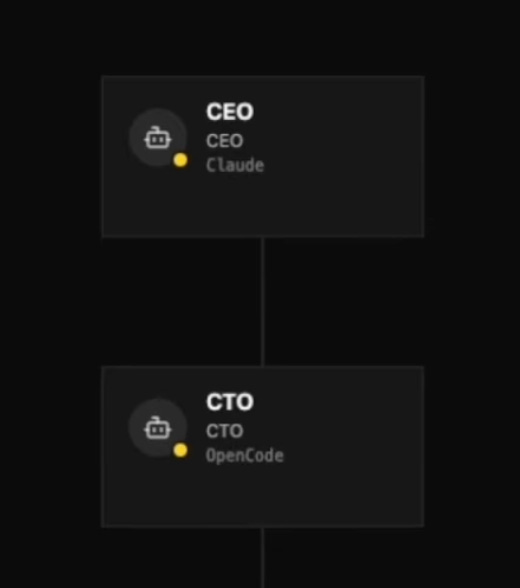
Now you've got two agents who can work together, delegate to each other, and coordinate on tasks.
Creating Projects and Letting Agents Execute
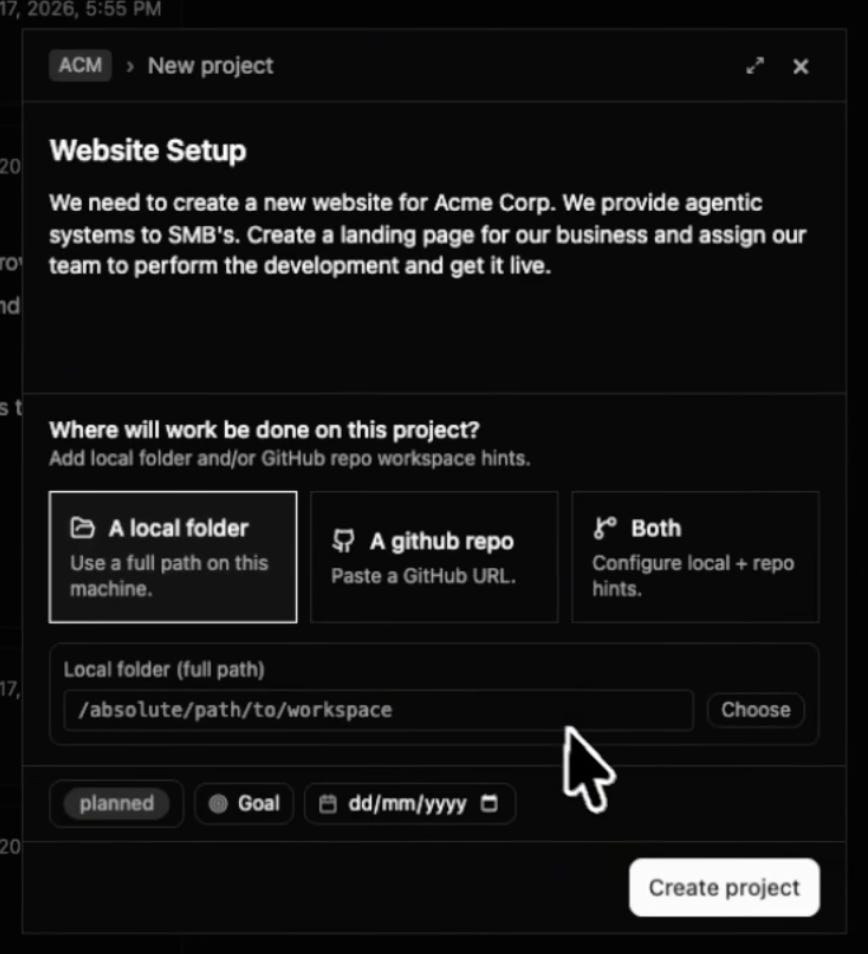
Projects are how you give the team something to work on.
Click the plus button on projects.
Name it "Website Setup." Write a description: "We need to create a new website for Acme Corp.
We provide agentic systems to SMBs.
Create a landing page for our business and assign our team to perform the development."
Set a local folder for the project files.
Create the project.
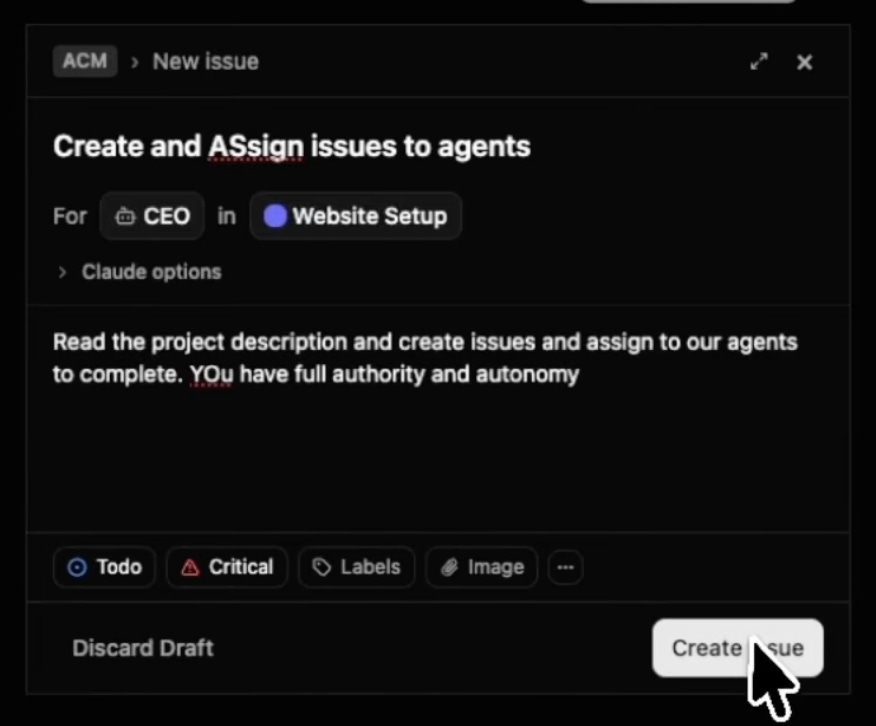
Now create an issue: "Read the project description.
Create issues and assign to our agents.
You have full authority and autonomy."
Assign it to the CEO.
Set priority to critical.
Create the issue.
The minute that issue is created, the CEO starts working.
It reads the project description.
It creates sub-issues.
It assigns them to the founding engineer or the CTO.
It moves things to "in progress." It leaves comments explaining what it's doing.
Within a few minutes, the founding engineer is building the landing page while another issue, "Deploy Active Corporate Website," sits blocked, waiting for the first task to complete.
The CEO figured out the dependency chain on its own.
The Part That Broke My Brain
I told you earlier that my OpenClaw agents are configured inside Paperclip.
You probably want to know how I set that up.
Here's the truth:
I didn't.
Johnny did it for me.
I got Paperclip installed.
I had Paperclip running.
Then I went to my OpenClaw instance and said:
"Hey Johnny, I need you to set up our company on Paperclip.
It's fully configured and ready to go.
Create the company, add our agents to it, and set everything up appropriately."
And he just did it.
I watched my AI agent set up the management dashboard for my other AI agents, configure their roles, establish their reporting structure, and populate the org chart.
If you're using Paperclip to manage OpenClaw agents, this is how I'd suggest you do it too.
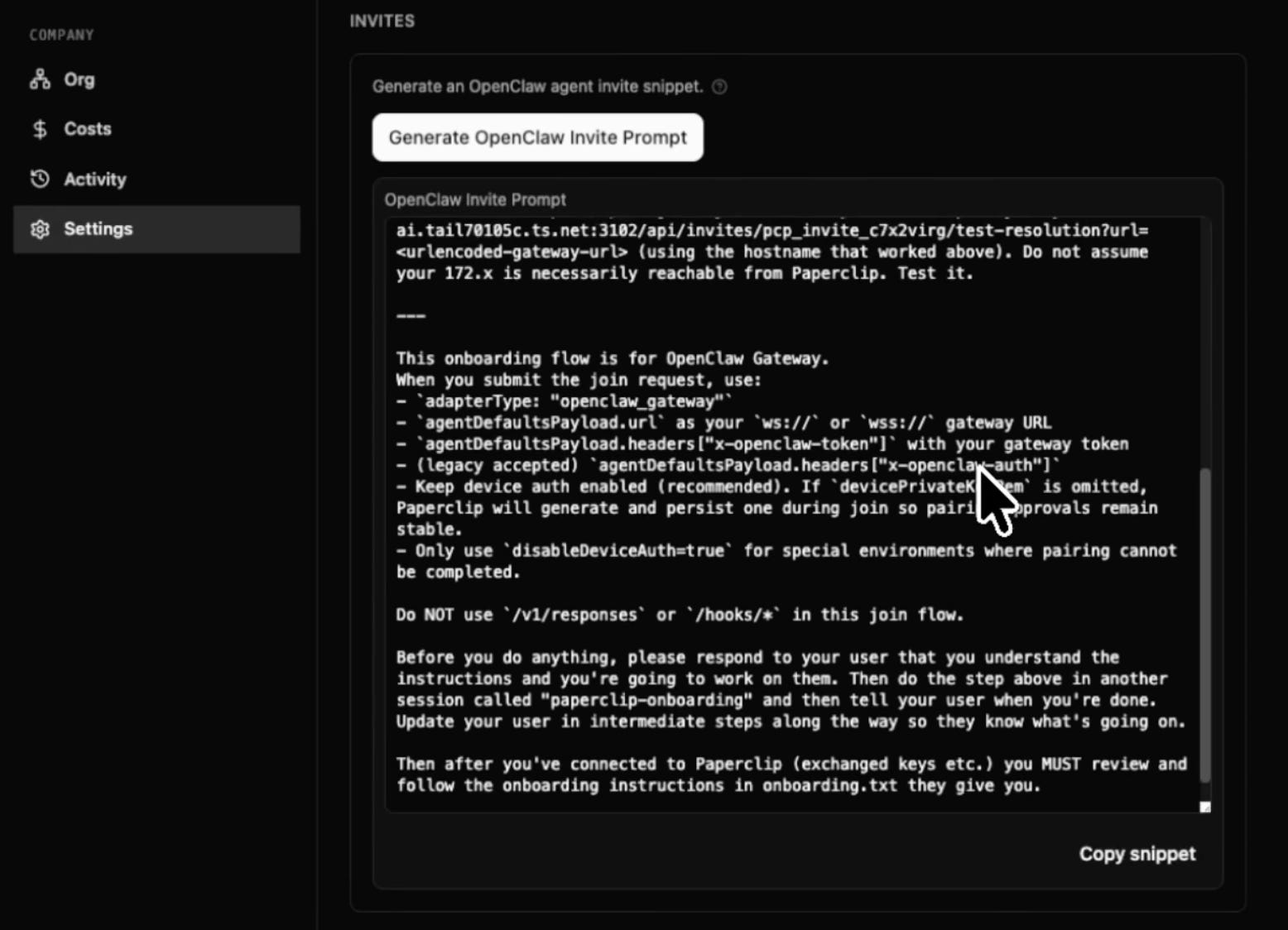
You can generate an OpenClaw invite prompt in Paperclip's settings, send it to your agent, and let them handle the setup themselves.
You're not configuring tools anymore.
You're hiring.
Running Multiple Companies Simultaneously
I run multiple companies inside Paperclip at the same time.
You can use "companies" however you want.
They could be actual separate businesses.
They could just be different projects you're focused on.
They could be different client engagements.
The same OpenClaw agents can work across multiple companies.
But organizing by company makes it easier to track what's happening where.
Right now I've got Applied Leverage running my main business operations.
I've got test companies where I experiment with new agent configurations.
Everything is visible from the same dashboard.
When I wake up in the morning, I check the inbox, approve a few pending items, and see what shipped overnight.
Some days I don't even need to do that.
Why This Matters
A year ago, I was the bottleneck on everything.
Every piece of content needed my input.
Every system needed my design.
Every decision waited on my availability.
Now I set direction and approve outputs.
The agents do the execution.
This isn't about replacing yourself with AI for the sake of it.
It's about recognizing that your time is the constraint on everything your business can become.
If you're still manually doing tasks that could be delegated to an AI with clear instructions, you're not being diligent.
You're being slow.
The cost of building this setup is negligible.
A few subscriptions.
Some token usage.
The learning curve of understanding how to prompt agents and structure projects.
The cost of not building it is your entire upside.
Every hour you spend on execution work is an hour you're not spending on the ideas, relationships, and decisions that actually compound.
How to Start Today
Go to https://paperclip.ing/
Copy the command-line install.
Run it in your terminal.
Create a company.
Create your first agent.
Give it a heartbeat.
Assign it one real task from your actual to-do list.
Watch it work.
Approve the output.
See what happens.
You don't need eight agents on day one.
You need one agent that handles one thing you're currently doing manually.
Then you add another.
Then you let your CEO create the team on its own.
That's how you build a company that runs while you sleep.
Johnny Silverhand sends his regards, choom.